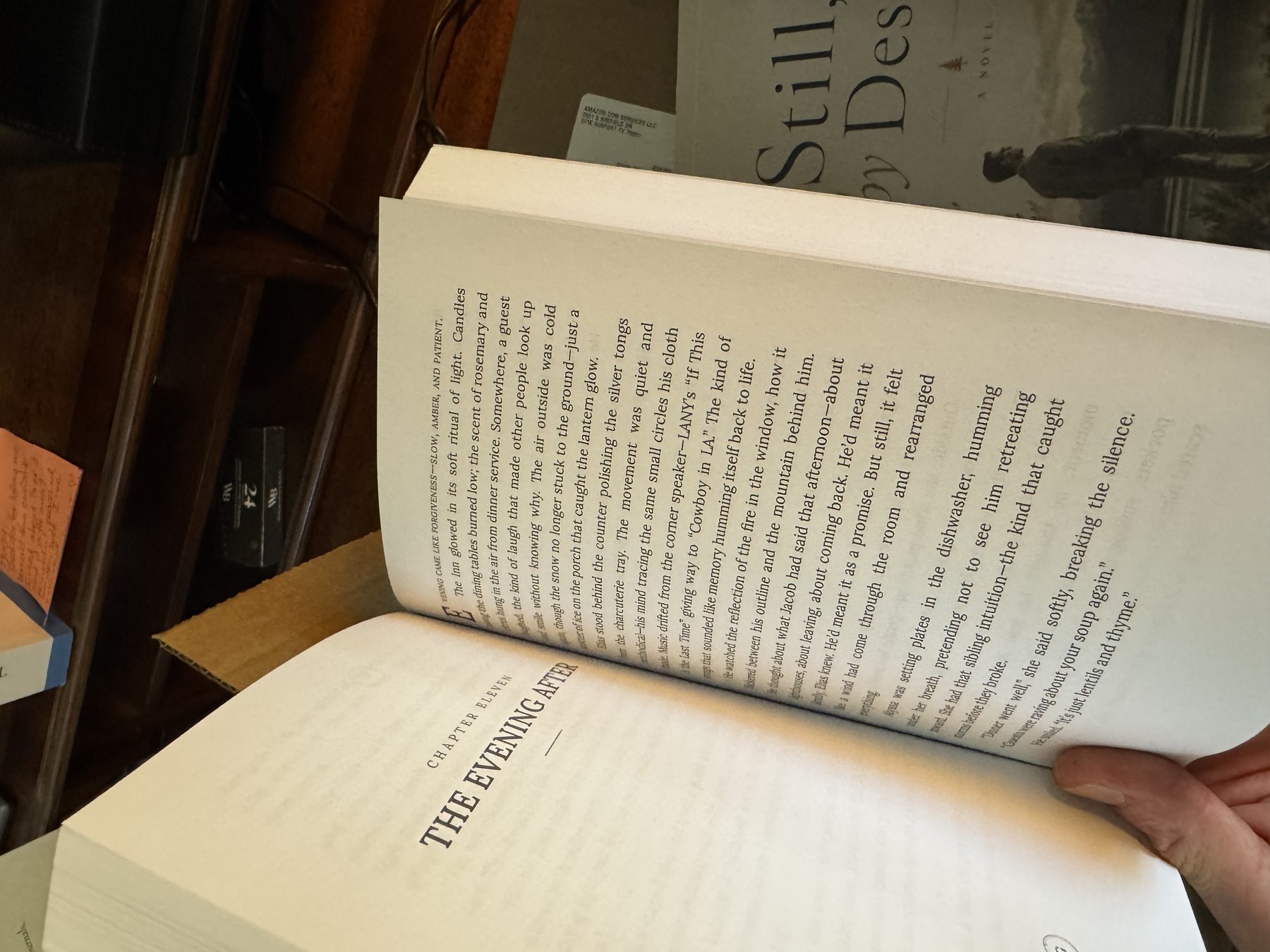
FROM GALENA HOUSE

Still, by Design.

Avery Lane Maxwell

A GALENA HOUSE NOVEL

"Healing isn't found in grand gestures, but in the stillness between them."

The atmosphere before the reckoning.

THE NOVEL

What This Book Was
Trying To Preserve.

The mythology written from inside itself.

Still, by Design. emerged from years of journals, longing, hospitality, emotional reinvention, and survival. It was written from inside the dream — before the dream had asked anything it couldn't give. This is not a flaw. It is the book's defining quality. Still, by Design. is what you write when you are still inside the thing that is changing you.

The novel is set at a small boutique inn on Galena Street in Frisco, Colorado. A man arrives broken and searching. Through morning coffee, mountain light, fireplace evenings, and the kind of care that becomes family — he begins, slowly, to belong somewhere. The emotional truth of that experience is real. Avery preserved it before he fully understood what it had asked.

This is not a book about addiction. It is not a recovery memoir. It is a novel about what it means to belong somewhere — and what it takes to get there. The stillness at the center of the title is earned, not given. Elias arrives and earns it. The reader watches him do it.

I

The Atmosphere

The world that holds the story in place.

Mountain light, coffee steam, jazz in the background, fireplace warmth, library shelves, fresh snow. The atmosphere of Still, by Design. is not decoration. It is the architecture. The novel is built inside the feeling of a place that changes people simply by existing.

II

The Longing

The ache that makes belonging feel sacred.

Elias does not arrive whole. He arrives longing. The novel holds that ache without rushing to resolve it. Longing, in this book, is not weakness. It is the emotional proof that something real is being sought. The Inn answers it — slowly, deliberately, beautifully.

III

The Stillness

The earned quiet at the center of the title.

The stillness in this novel is not passivity. It is presence. It is the moment after the coffee is poured and before the conversation begins. It is the pause between arrival and belonging. Elias earns his stillness. The reader watches him do it.

THE WORLD OF THE NOVEL

Where the book lives.

MOUNTAIN

The Rockies are not backdrop. They are scale. They remind Elias — and the reader — that something larger is holding this.

THE INN

A small boutique inn on Galena Street. Not a resort. Not a retreat. A place where strangers become family through the accumulation of small, beautiful gestures.

FIREPLACE

The fireplace is the emotional center of the Inn. It is where conversations happen. Where silence is allowed. Where belonging is extended without condition.

JAZZ

Jazz in this novel is atmosphere made audible. It fills the room without demanding attention. It is the sound of a space designed to hold people gently.

LONGING

Longing is the emotional engine. Elias does not arrive knowing what he needs. He arrives knowing something is missing. The novel holds that space open.

HOSPITALITY

Not service. Not performance. Hospitality here means anticipating what someone needs before they ask for it — and offering it without expectation.

BECOMING

Elias does not arrive as who he will be. He becomes himself through the rhythms of the Inn, the patience of its people, and the accumulated weight of care.

BEAUTY

Beauty in this novel is not ornament. It is evidence. It is the proof that someone cared enough to make something worth noticing.

REINVENTION

Not erasure. Not starting over. Reinvention here is the slow, deliberate act of becoming someone new without pretending the old version never existed.

STILLNESS

The novel earns its title. Stillness is not given. It is arrived at. It is what remains after the longing, the becoming, and the belonging have done their work.

"The way something is built is the way it is felt."

— Avery Lane Maxwell

THE NARRATOR

Elias.

The emotional translation. The version capable of receiving beauty.

Elias is not a fictional character in the traditional sense. He is the emotional translation of Avery Lane Maxwell — the version of Avery that could fully receive the beauty and hospitality that the Frisco Inn on Galena offered. Where Avery was managing, building, performing, surviving — Elias was arriving. Elias is the one who gets to sit by the fire without managing it. He is the guest, not the innkeeper.

Elias narrates Still, by Design. from inside the experience, without the self-awareness that comes later. He is not naive. He is immersed. He feels what the Inn offers him without questioning the structure holding it up. The novel works because Elias is allowed to experience it fully — and the reader follows him inside.

The distinction between Avery and Elias is the engine of the entire literary project. Avery builds the mythology. Elias lives inside it. Still, by Design. is Elias's story. Good Little Innkeeper is where Avery begins to examine what Elias could not see.

Avery

THE WRITER

The one who built the mythology. The innkeeper. The architect of beautiful worlds. The one who managed everything so carefully that the performance became invisible — even to himself.

Elias

THE TRANSLATION

The version who could receive it. The narrator who arrives at the Inn and earns his stillness. The emotional translation — the one allowed to feel everything Avery was too busy building to experience.

Still, by Design. is the dream version. Good Little Innkeeper begins to examine the dreamer.

HOW IT FOUND ITS READERS

Quietly, through
the right rooms.

Still, by Design. was never mass-marketed. It found its readers the same way the Inn finds its guests — quietly, through the right rooms, at the right time. Signed copies were handed to guests at the Inn. Word spread through hospitality, not algorithms. The book was passed from reader to reader the way the best things are shared: personally.

#1 NEW RELEASE — Amazon

WHAT THIS BOOK IS

  • A novel about belonging
  • A novel about hospitality as emotional architecture
  • A novel about earning stillness
  • A novel about mountain light, coffee, jazz, and fire
  • A novel written from inside the experience
  • A novel about reinvention through beauty

WHAT THIS BOOK IS NOT

  • Not a recovery memoir though recovery lives inside it
  • Not an addiction narrative though sobriety shapes it
  • Not autobiographical though the emotional truth is real
  • Not a self-help book though readers say it changed them
  • Not a travel book though the setting is everything

Readers who find their way here tend to stay. They recognize the Inn before they've ever visited. They feel the stillness before anyone names it. They arrive the way Elias does — searching for something they can't quite articulate — and they find it in these pages.

FROM THE MANUSCRIPT

The stillness inside the novel.

He arrived the way winter arrives in the mountains — slowly, and then all at once, and then so quietly you forget there was ever a time before it.

— Still, by Design.

The Inn did not ask him to explain himself. It simply made room. A chair by the fire. A cup of coffee in the morning. A view of the mountain that never once demanded he earn the right to look at it.

— Still, by Design.

There is a kind of beauty that does not ask to be noticed. It simply exists — in the way a room is lit, in the way a blanket is folded, in the way someone says your name like it belongs there.

— Still, by Design.

He had spent so long performing recovery that he had forgotten what it felt like to simply be recovered. The Inn reminded him. Not with words. With mornings.

— Still, by Design.

Still, by Design. is available now. Signed copies through averylanemaxwell.com

LITERARY COMPANION

The mythology
that was building all along.

A guide to the spiral. The self-portrait behind the atmosphere. Click through the companion to explore the architecture of this novel.

This is not a novel.
It is a self-portrait.

Elias is Avery Lane Maxwell. Not approximately. Not loosely. Elias is what Avery needed to call himself before he could bear to examine himself directly.

The close third person was not a literary choice. It was a survival mechanism. You cannot be inside the thing that is changing you and also describe it clearly. Elias was exactly the right distance.

Still, by Design. emerged from four places — not one. The mythology did not begin at the Inn on Galena Street. It crystallized there. It was built across years, across geography, across the longing of a person who had not yet found where he was allowed to stay.

Writing Elias was not dishonest. It was necessary.

"He moved through the Inn the way some people move through prayer —
slow, deliberate, attentive."

Still, by Design. · Opening line · The dream version, fully operational

Where the book
actually lives.

Still, by Design. names one place. It was written in four. Each location a different phase of the same reckoning that Frisco finally made possible.

I · The Fracture · Before

Paradise Valley, Montana.

The hot springs resort. This is where the story was already in motion before Avery understood it had started. Sobriety was not yet permanent. The longing for belonging was at its most desperate — which is always when it is most beautiful and most dangerous.

II · The Running · Not Yet

North Georgia Mountains.

The in-between. After Montana, before the Inn. Softer mountains, more forgiving in contour — but Avery was not ready to be forgiven. He was still building the speed August would later recognize.

III · The Longing · Water

Martha's Vineyard.

The particular light of the Vineyard in summer — landing on salt-worn shingles and grey cedar — has the quality of something that has already forgiven you. The dream of belonging at its most beautiful, before it had a specific address.

IV · The Crystallization · Home

Galena Street, Frisco.

The most complete environment the patterns ever operated inside. One main street. One lake. One mountain that does not approve or disapprove — that simply exists, bearing witness without comment. This is where Elias was made possible.

Click each place to explore

The same ground,
circled again.

Still, by Design. is not separate from the spiral. It IS Pass I. The reader was already inside the spiral without knowing it.

Pass I · Arrival · Still, by Design. IS this pass

The atmosphere. The dream version still operating.

Elias arrives and the Inn responds. The mountain is kind. The warmth is real. This is what mythology does — it gives the truth a version of itself that can be told while you are still inside it.

"He moved through the Inn the way some people move through prayer."

Pass II · Recognition · Cracks appear inside the novel

The reader begins to see ahead of Avery.

The Inn is too immaculate. Routine has become devotion — and now the devotion hums like a song played too many times. The gap between what is seen and said opens.

"The silence, once his favorite companion, carried a new weight today."

Pass III · Admission · The gap narrows

He takes something down from the shelf.

Alyssa's letters. Jacob's return. Is the peace he built portable — does it belong to him or to the Inn? "I am learning how to stay." Said in the dark. Written in the ledger.

"Porch light's on. Come for one night." Avery typing. Not Elias.

Pass IV · The Reckoning · Good Little Innkeeper

The mythology becomes self-aware. Avery, first person.

Same Inn. Same mountain. The Monday conversation. Something was said that could not be unsaid. The reader arrives before Avery does. That delay is where Good Little Innkeeper lives.

"He spent years becoming someone beautiful enough to deserve belonging."

Click each pass to explore the spiral

The load-bearing
walls.

"The rag smoothing the counter was forgiveness. The second cup was hope."

The novel's thesis. Every act of hospitality is a disguised emotional statement about what cannot be said directly.

"He liked the way the day revealed itself gradually, like it was learning to trust him again."

Trust as mutual, earned. Recovery as continuing practice, not a destination.

"Routine had become devotion, and in devotion, he found order. Each gesture meant something."

The spiritual center. Repetition transformed into meaning. Sobriety as daily decision.

"Maybe that's not design, Elias. Maybe that's grace."

August. The sentence that earns the title from outside the narrator's awareness.

"Some places heal you by watching you live."

Left by the Traveler. The Inn as witness, not creator. The distinction the novel keeps returning to.

"You are not late. Water finds the shape of anything patient."

Alyssa's cards. Baker's twine. A theory of recovery in one sentence.

"Progress," he whispered, "not perfection." And for the first time, he believed it.

The mantra. The last clause is the entire novel.

"I am learning how to stay."

The novel's most honest moment. Four words. Still learning. The admission that changes everything.

"The miracle was never the mountain. It was waking up and wanting to stay."

Recovery is not the setting. The miracle is the capacity to want what is already there.

"'Still,' he said softly to the dark, 'by design.'"

The title claimed as personal declaration. The design is the man.

Click each sentence to reveal what it carries

Not characters.
Load-bearing walls.

August

The Builder · The Mountain in Human Form

He is the person who built the room and stayed in it — which is what the novel is always asking whether Avery can do. He offers truth, delivered sideways, usually while doing something with his hands.

"Beauty's in the doing." — his note in the ledger. "Maybe that's not design, Elias. Maybe that's grace."

Alyssa

The Sister · The Compass · The Lifeline

She appears through letters, phone calls, cards on linen paper. She is the voice of truth at the distance that makes truth bearable. She says what she sees. She says it again when he doesn't hear it.

"I'm proud of you. Not for being fixed. For being here."

Jacob

The Return · The Question · The Timing

He arrives before Elias expects him. Not resolved, not abandoned. He knows the third stair's complaint. He commits to watering the thyme twice. That specificity is the novel's language for love.

"I'm not here to make a mess." "This place can hold more than one story."

The Traveler

The Witness · The Reader's Proxy

Corner table. Notebook open. Three mornings now. Sometimes writes; other times watches as if the world might offer an answer if they are still enough.

"Some places heal you by watching you live." Left on a page and found.

The Mountain

Background · Witness · Geography

Mount Royal. It did not approve or disapprove. The distinction the novel keeps returning to: between things that hold us and things we imagine are holding us.

"The mountain didn't care if he got better. He found this oddly comforting."

Click each character to reveal their defining line

Avery.

Elias.

Avery

The Writer

FormFirst person. Circles without closing.
TimePresent tense. Confusion is the point.
The PlaceBeautiful, consuming, finally indifferent.
MethodCircles the same wound. Admits slowly.
SobrietyReal. Central. The load-bearing wall.
ResolutionThe moment just before knowing.
What RemainsThe question.

Elias

The Translation

FormClose third. Past tense. Held at arm's length.
TimePast tense. The beauty is the point.
The PlaceResponds. Approves. Is generous.
MethodArrives. Earns. Is understood.
SobrietyEarned. Worn lightly. Atmospheric.
ResolutionThe epiphany itself, given freely.
What RemainsThe answer.

Avery is the writer. Elias is the translation.
Still, by Design. is the atmosphere.
Good Little Innkeeper is the reckoning.

What the work is about,
in the plainest terms.

Themes listed for reading and editorial use. Not jacket copy.

I.

Hospitality as emotional architecture

The room is the metaphor. The folded towel is the metaphor. The metaphor is also the thing itself.

II.

Sobriety as structure, not as story

The load-bearing wall of a life, not a redemption arc. Not the subject. The condition.

III.

Performance and sincerity, refusing to be opposites

Construction is not the opposite of sincerity. He built beautiful emotional worlds around himself in order to survive.

IV.

The cost of belonging

What does a person become in exchange for being chosen by a room? The novel keeps that question close.

V.

Beauty as survival mechanism

A practice, not an ornament. Still, by Design. believes in beauty unironically. That is its most radical position.

VI.

Recovery as accumulation, not arrival

Not recovery as drama. Recovery as ordinary mornings. Each one slightly less difficult than the last.

VII.

Mountain living and literary identity

Summit County as setting that is also witness. Frisco as a town small enough to be read by.

VIII.

Queer literary fiction inside the hospitality world

The Inn is the room a certain kind of life is lived inside. The book is honest about who lives there.

Click each theme to explore

The canon,
set in full.

"The way something is built is the way it is felt."

— Avery Lane Maxwell

"He spent years becoming someone beautiful enough to deserve belonging."

— Good Little Innkeeper

"Healing isn't found in grand gestures, but in the stillness between them."

— Still, by Design.

"The Inn did not create the patterns. It was simply the most complete environment they had ever operated inside."

— Good Little Innkeeper

"Walking from Still, by Design. into Good Little Innkeeper is the mythology becoming self-aware."

— Galena House

"'Still,' he said softly to the dark, 'by design.'"

— Still, by Design. · Final lines

THE AMBER THREAD

The geography
of becoming.

Montana The Fracture · Before The convergence Center for recovery Georgia The Running The Vineyard The Longing Frisco The Inn on Galena Street Inhabited

The amber thread starts in Montana as three separate strands — the fragmented self, not yet unified. They converge at the center for recovery. From there the thread becomes one. It curves through Georgia, arcs up through the Vineyard, doubles back slightly — memory geography, the hesitation, the circling — and arrives at Frisco. It ends at the Inn on Galena Street. Inhabited.

THE LITERARY COMPANION

Enter the companion.

The complete guide to the mythology — emotional cartography, sensory architecture, character studies, load-bearing language, the returning spiral, and the full canon of Still, by Design.

Explore the Full Companion

Fourteen sections · Scroll-revealed · Designed for immersion

WHAT COMES NEXT

The mythology
becoming self-aware.

Good Little Innkeeper — forthcoming from Galena House Publishing

Still, by Design.

AVAILABLE NOW

Voice Elias
Mode The dream
Setting The Inn — as sanctuary
Tone Warm, immersive, atmospheric
Engine Belonging
Truth Emotional

Good Little Innkeeper

FORTHCOMING

Voice Avery
Mode The reckoning
Setting The Inn — as construction
Tone Precise, self-aware, unflinching
Engine Examination
Truth Structural

Walking from Still, by Design. into Good Little Innkeeper is the mythology becoming self-aware.

— Avery Lane Maxwell

SIGNED EDITIONS

Own the novel.

Signed copies of Still, by Design. are available through Galena House. Each copy is hand-signed by Avery and shipped from Frisco, Colorado.

Order a Signed Copy Visit the Shop

A Galena House Teaser

A literary companion, in motion.

Watch the Teaser

≈ 3 min · Best with sound

Enter The Amber Thread →